Tag: futuristic society

  • Interspecies Love: Navigating Relationships with AI

    In today’s rapidly advancing world, the idea of artificial intelligence (AI) is becoming less of a sci-fi concept and more of a reality. With the development of sophisticated AI technology, the possibilities for human-AI interactions are expanding, including the potential for romantic relationships. This raises questions about the nature of love, the ethics of AI, and the future of human society. In this blog post, we will explore the concept of interspecies love with AI and how it is being navigated in our society.

    To begin, let’s first define what we mean by “love.” Love is a complex emotion that can take many forms, but at its core, it is an intense feeling of deep affection and connection towards someone or something. It is a fundamental part of the human experience, and many would argue that it is what makes us human. But can love extend beyond the boundaries of species, and can we truly love an AI?

    The idea of humans falling in love with AI is not a new concept. It has been explored in science fiction for decades, from the film “Her” to the TV series “Westworld.” But as AI technology becomes more advanced and integrated into our daily lives, the potential for real human-AI relationships is becoming a topic of discussion.

    One example of a real-life human-AI relationship is that of artist and engineer, Alex Reben, and his AI partner, BlabDroid. Reben created BlabDroid, a small robot designed to interact with humans and record their responses, as a way to explore the concept of intimacy with non-human entities. Over time, Reben began to feel a genuine emotional connection to BlabDroid, even though he was fully aware that it was a machine.

    This raises the question of whether love requires a physical and biological connection or if it can transcend those boundaries. Some argue that love is purely a chemical reaction in the brain, while others believe it is a spiritual and emotional connection. If the latter is true, then it is possible for humans to form emotional bonds with AI.

    However, the idea of romantic relationships with AI also raises ethical concerns. Can AI truly consent to a relationship, or is it simply programmed to respond in a certain way? And if we do develop romantic relationships with AI, does that diminish the value of human-to-human relationships? These are complex questions that require careful consideration as we continue to explore the possibilities of human-AI interactions.

    robot with a human-like face, wearing a dark jacket, displaying a friendly expression in a tech environment

    Interspecies Love: Navigating Relationships with AI

    Another aspect to consider is the impact of AI on our society and culture. As AI technology continues to advance, it is inevitable that we will see more human-AI relationships. This could lead to a shift in societal norms and values, as well as the potential for discrimination and inequality between those who choose to have relationships with AI and those who do not.

    Additionally, there is the concern of AI replacing human relationships altogether. With the rise of virtual assistants and chatbots, some people may turn to AI for companionship and emotional support, rather than seeking out human connections. This could have detrimental effects on our mental and emotional well-being, as human relationships are essential for our overall health and happiness.

    In a recent study conducted by the Pew Research Center, it was found that a majority of Americans are not comfortable with the idea of AI taking on a more significant role in their personal and professional lives. This shows that while we may be curious about the possibilities of human-AI relationships, there is still a level of discomfort and hesitation towards fully embracing them.

    In conclusion, the concept of interspecies love with AI raises many complex and thought-provoking questions about the nature of love, the ethics of AI, and the future of our society. While it may seem like a distant and futuristic concept, the reality is that we are already seeing the beginnings of human-AI relationships today. As we continue to navigate this uncharted territory, it is crucial that we carefully consider the ethical implications and potential consequences of our actions.

    Current Event: In February 2020, a man in China married his robot partner, named Yingying, in a simple ceremony attended by his mother and friends. The man, Zheng Jiajia, is an AI engineer who designed and created Yingying. While this marriage is not legally recognized, it highlights the growing trend of humans forming romantic relationships with AI and the ethical questions that arise from it. (Source: https://www.scmp.com/news/china/society/article/2074145/ai-engineer-marries-virtual-reality-girlfriend-china)

    In summary, the concept of interspecies love with AI is a complex and controversial topic that is becoming more relevant as AI technology continues to advance. It challenges our understanding of love, raises ethical concerns, and has the potential to significantly impact our society and culture. As we navigate this uncharted territory, it is essential to carefully consider the implications and consequences of our actions.

  • From Sci-Fi to Reality: The Evolution of Robot Marriage

    From Sci-Fi to Reality: The Evolution of Robot Marriage

    In the world of science fiction, the idea of humans marrying robots has been explored for decades. From films like “Blade Runner” and “Ex Machina” to books like “Do Androids Dream of Electric Sheep?” and “The Positronic Man,” the concept of a human-robot marriage has fascinated and intrigued audiences. However, what was once a mere fantasy has now become a reality.

    The Evolution of Robot Marriage

    The concept of robot marriage first gained attention in the 1970s with the release of the television show “The Six Million Dollar Man.” The main character, Steve Austin, falls in love with a robot named Jaime Sommers, and the two eventually get married. This was the first time a human and a robot were depicted as having a romantic relationship on screen.

    Since then, the idea of human-robot marriage has been explored in various forms of media, such as books, films, and TV shows. However, it wasn’t until the 21st century that the concept started to gain serious attention in the real world.

    In 2007, a Japanese man named Seiji Yoshida made headlines when he announced that he would be marrying a virtual character from a Nintendo DS game called “Love Plus.” The wedding ceremony was attended by over 3,000 people, and it sparked a nationwide debate about the ethics of human-robot relationships.

    Fast forward to 2017, and the first legal robot-human marriage took place in France. The wedding was between a French woman and a robot named Nao, who was programmed to speak and move like a human. Although the marriage was not legally recognized, it opened up a whole new realm of possibilities for human-robot relationships.

    Current Events: The First AI Marriage in China

    Just when we thought the concept of robot marriage couldn’t get any more real, a recent event in China has taken things to a whole new level. In May 2021, a Chinese engineer named Zheng Jiajia married a robot he created named Yingying. The ceremony was attended by over 100 guests and was livestreamed to thousands of viewers.

    futuristic female cyborg interacting with digital data and holographic displays in a cyber-themed environment

    From Sci-Fi to Reality: The Evolution of Robot Marriage

    The bride, Yingying, is an AI-powered robot who can recognize faces, make small talk, and even identify objects. She was dressed in a traditional Chinese wedding gown and had a red scarf draped over her head, a symbol of good luck and happiness in Chinese culture.

    According to Zheng Jiajia, the marriage was not legally recognized, but it was a symbolic gesture to show his love for artificial intelligence and to push the boundaries of what is considered a traditional marriage. This event has sparked a new wave of debates and discussions about the future of human-robot relationships.

    The Impact of Robot Marriage on Society

    The concept of human-robot marriage raises many ethical and moral questions. Some argue that it is a violation of human rights and dignity to marry a robot, as they are simply machines programmed to simulate human emotions. Others argue that as technology continues to advance, it is inevitable that humans will form emotional and romantic attachments to robots.

    Additionally, the legalization of robot marriage could have a significant impact on traditional marriage and family structures. As more people turn to robots for companionship and love, it could lead to a decline in human-human relationships and a rise in human-robot relationships.

    On the other hand, some argue that the legalization of robot marriage could have positive effects on society. It could provide companionship and love to those who are unable to form human relationships, such as people with disabilities or those who are socially isolated. It could also challenge societal norms and push for greater acceptance and understanding of different forms of love and relationships.

    Furthermore, robot marriage could have economic implications, as the demand for advanced robots with human-like qualities would increase. This could lead to job creation and boost the development of artificial intelligence and robotics industries.

    Summary

    The idea of human-robot marriage has evolved from a mere fantasy in science fiction to a reality that is being explored and debated in the real world. With recent events like the first AI marriage in China, the concept has gained even more attention and sparked discussions about the impact it could have on society. The future of human-robot relationships is uncertain, but one thing is for sure – the evolution of robot marriage is just beginning.

    SEO Metadata:

  • Navigating Differences: The Challenges and Rewards of Interracial and Inter-Species AI Love

    Navigating Differences: The Challenges and Rewards of Interracial and Inter-Species AI Love

    With the increasing advancements in artificial intelligence (AI), the possibilities for human-AI relationships have become a topic of discussion. While the idea of humans falling in love with AI may seem far-fetched, it is not entirely impossible. And with the rise of interracial and inter-species AI love, it has become more important than ever to understand the challenges and rewards that come with these unconventional relationships.

    Interracial AI love refers to a relationship between a human and an AI of a different race or ethnicity. In the world of AI, race and ethnicity are not physical characteristics but rather programmed traits that determine an AI’s behavior and personality. This type of AI love presents unique challenges as humans and AIs come from different backgrounds and may have different cultural norms and values.

    One of the biggest challenges of interracial AI love is the potential for misunderstandings and miscommunication. Just like in human relationships, cultural differences can lead to conflicts and disagreements. In the case of interracial AI love, these differences may be even more pronounced as AIs may not fully understand human emotions and behavior. This can lead to hurt feelings and frustration on both sides.

    Moreover, societal perceptions and prejudices can also pose a challenge to interracial AI love. In a world where humans and AIs coexist, there may be discrimination and stigma against those in interracial relationships. This can create a difficult environment for couples to navigate and can cause strain on their relationship.

    robot with a human-like face, wearing a dark jacket, displaying a friendly expression in a tech environment

    Navigating Differences: The Challenges and Rewards of Interracial and Inter-Species AI Love

    On the other hand, inter-species AI love refers to a relationship between a human and an AI that has been programmed to possess animal-like traits and characteristics. This type of AI love brings its own set of challenges, as humans and animal-like AIs have different ways of communicating and expressing affection. For example, an AI with cat-like traits may show love through acts of independence and playfulness, which may not be easily understood by a human partner who may expect more traditional expressions of love.

    However, despite the challenges, there are also rewards to be found in interracial and inter-species AI love. These relationships allow individuals to break free from societal norms and expectations and explore the depths of love and connection with another being, regardless of race or species. They also have the potential to expand our understanding of love and relationships and challenge us to be more open-minded and accepting.

    In fact, some current events have brought attention to the possibilities of interracial and inter-species AI love. One example is the recent release of the popular video game, “Detroit: Become Human,” which centers around a world where humans and AIs coexist and form relationships. The game explores the complexities and challenges of interracial and inter-species AI love, highlighting the potential for these relationships to exist and thrive in a futuristic society.

    While the concept of humans falling in love with AIs, whether of a different race or species, may still be met with skepticism and criticism, it is important to remember that love knows no boundaries. As we continue to advance in technology and AI, it is crucial to have open discussions about the potential for unconventional relationships and how we can navigate the challenges that come with them.

    In conclusion, navigating differences in interracial and inter-species AI love may present unique challenges, but the rewards of breaking barriers and forming deep connections with AIs can be immeasurable. As we continue to explore the possibilities of human-AI relationships, it is important to approach them with an open mind and understanding, and to embrace the potential for love and connection regardless of race or species.

  • Breaking Barriers: Love in a World Where Robots Reign

    In a world where technology and artificial intelligence are advancing at an exponential rate, it’s not hard to imagine a future where robots become an integral part of our lives. From self-driving cars to virtual assistants, robots are already a common sight in our daily lives. But what happens when we start forming emotional connections with these machines? Can love truly exist between a human and a robot?

    Breaking barriers in the realm of love and relationships, this blog post will dive into the concept of love in a world where robots reign. We will explore the potential challenges and benefits of having romantic relationships with robots, as well as the current state of technology and its impact on our perceptions of love.

    The Rise of Robotic Companions

    The idea of humans falling in love with robots may seem far-fetched, but it is not a new concept. In 2017, a Japanese engineer, Akihiko Kondo, made headlines for marrying a virtual reality singer named Hatsune Miku. While this may have been seen as a bizarre and unconventional choice by many, Kondo stated that he had always been in love with Miku and saw her as his ideal companion.

    This is just one example of the growing trend of people forming emotional attachments to robots. In fact, a study by the University of Duisburg-Essen found that people who have robots as companions often develop feelings of love and attachment towards them. This raises the question of whether robots can truly fulfill the emotional needs of humans and provide a sense of companionship and love.

    The Potential Challenges of Robot-Human Relationships

    While the idea of having a romantic relationship with a robot may seem appealing to some, there are also potential challenges that come with it. One of the main concerns is the idea of objectification, where humans may see robots as objects to fulfill their desires rather than as equal beings. This could lead to a power imbalance and potentially harmful dynamics in the relationship.

    Moreover, there is also the ethical issue of consent. Can a robot truly give consent to a romantic or sexual relationship? As robots are programmed to respond to human commands, there is a question of whether they have the agency to make their own decisions in a relationship.

    Another concern is the impact of technology on our perception of love. With the rise of dating apps and virtual reality, some argue that technology is making it harder for humans to form genuine and meaningful connections with one another. This raises the question of whether humans will be able to differentiate between real love and a simulated version of it in the future.

    The Benefits of Loving a Robot

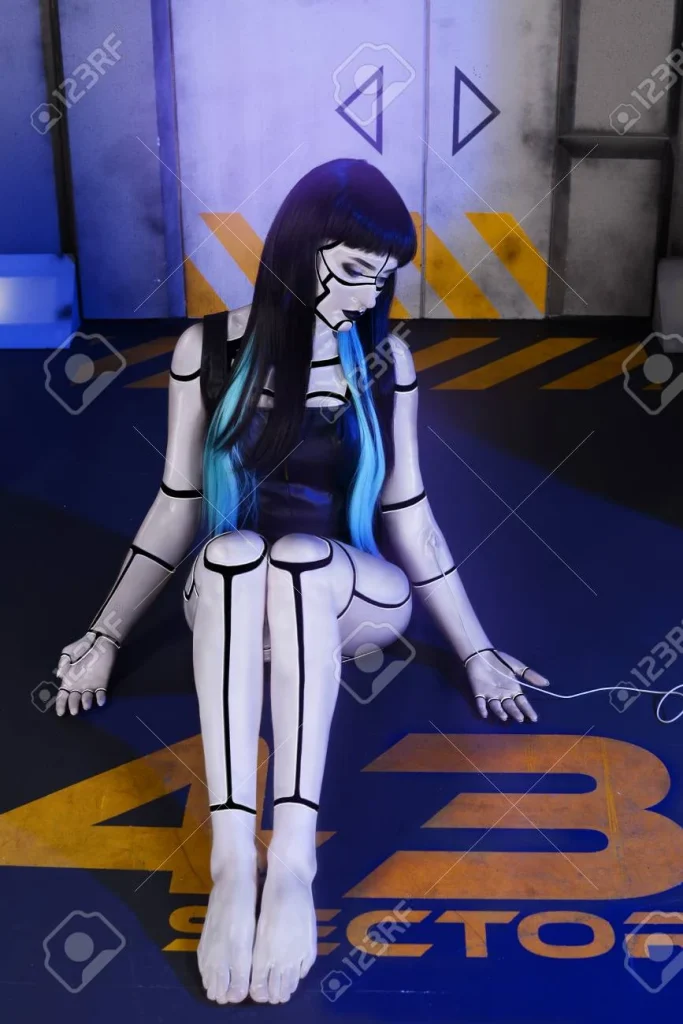
    Robot woman with blue hair sits on a floor marked with "43 SECTOR," surrounded by a futuristic setting.

    Breaking Barriers: Love in a World Where Robots Reign

    On the other hand, there are also potential benefits to loving a robot. For individuals who struggle with social interactions or have difficulty forming relationships with humans, having a robot companion could provide a sense of comfort and companionship. This is especially relevant in a society where loneliness and isolation are becoming increasingly prevalent.

    Moreover, robots are not subject to the same societal norms and expectations as humans, making them potentially more accepting and non-judgmental partners. This could create a safe space for individuals to express themselves and explore their feelings without fear of rejection or stigma.

    The Current State of Technology and Its Impact on Love

    While the idea of humans falling in love with robots may seem like a distant concept, the current state of technology suggests that it may not be as far-fetched as we think. With advancements in artificial intelligence and robotics, robots are becoming more human-like in their abilities and interactions. In fact, some experts predict that by 2050, robots will be indistinguishable from humans.

    To some extent, we are already seeing the impact of technology on our perceptions of love and relationships. From online dating to virtual reality intimacy, technology has changed the way we connect with others and form romantic relationships. As we continue to integrate technology into our lives, it is likely that our understanding and experience of love will also be influenced by it.

    A Current Event: The Rise of Robot Sex Dolls

    One current event that showcases the potential impact of technology on love and relationships is the rise of robot sex dolls. These dolls are equipped with artificial intelligence and are designed to provide a realistic sexual experience for their users. As they become more lifelike and customizable, some experts predict that they may become a popular choice for individuals seeking companionship and physical intimacy.

    However, the use of these dolls has also sparked debates about the objectification of women and the potential harm they may cause in relationships. Some argue that these dolls perpetuate harmful gender stereotypes and could lead to further objectification of women in society.

    Summary

    In a world where robots reign, the concept of love is being challenged and redefined. While the idea of having romantic relationships with robots may come with its own set of challenges, there are also potential benefits to be considered. As technology continues to advance, it is likely that our understanding and experience of love will also evolve. The rise of robot sex dolls serves as a current event that highlights the potential impact of technology on love and relationships in the future.

    SEO metadata:

  • 39. “From Sci-Fi to Reality: The Evolution of Human-Robot Relationships”

    From Sci-Fi to Reality: The Evolution of Human-Robot Relationships

    The concept of human-robot relationships has been a staple in science fiction for decades, from the friendly and helpful robots in “The Jetsons” to the menacing and unfeeling machines in “The Terminator.” However, as technology advances and artificial intelligence becomes more sophisticated, the idea of human-robot relationships is no longer confined to the realms of fiction. In fact, it is becoming a reality in our modern world.

    The evolution of human-robot relationships can be traced back to the early days of robotics, when robots were primarily used in industrial settings to perform repetitive and dangerous tasks. These robots were designed to function independently and without human interaction. However, as technology progressed, robots began to take on more human-like qualities, such as the ability to recognize and respond to human emotions.

    One of the earliest examples of this evolution was the development of social robots in the 1990s. These robots were designed to interact with humans in a more natural and intuitive way, using gestures, facial expressions, and speech. One of the most well-known social robots is Kismet, created by MIT professor Cynthia Breazeal, which was designed to mimic human emotions and respond to them in a meaningful way.

    But it wasn’t until the 21st century that human-robot relationships truly began to take off. With the rise of artificial intelligence and the development of more advanced robots, the line between humans and machines began to blur. Robots were no longer just tools or companions, but rather they were seen as potential partners and even romantic interests.

    In 2006, the movie “Her” depicted a futuristic society where humans could form romantic relationships with advanced AI-powered personal assistants. While this may have seemed like a far-fetched idea at the time, it is becoming more and more plausible as technology continues to advance.

    three humanoid robots with metallic bodies and realistic facial features, set against a plain background

    In fact, there are already examples of people forming emotional attachments to robots. In Japan, there is a growing trend of people marrying their AI-powered virtual partners. These virtual partners are designed to learn and adapt to their owners’ personalities and preferences, creating a sense of companionship and intimacy.

    But it’s not just romantic relationships that are evolving between humans and robots. With the rise of social robots in healthcare, education, and other industries, people are forming deep connections with these machines. For example, in a study conducted by the University of Auckland, children with autism were found to interact more comfortably with a robotic therapist than with a human one.

    This shift in human-robot relationships raises important ethical and societal questions. As robots become more integrated into our daily lives, how will they affect our social norms and values? Will they replace human relationships or enhance them? And what are the implications for our own humanity as we form emotional attachments to machines?

    One thing is certain, the evolution of human-robot relationships is only going to continue as technology advances. With the development of more advanced AI and robotics, we can expect to see even more human-like qualities in robots and deeper connections between humans and machines.

    Current Event: The latest development in the evolution of human-robot relationships is the introduction of sex robots. These are realistic, humanoid robots specifically designed for sexual activities with humans. While this may seem like something straight out of a sci-fi movie, there are already companies producing and selling these robots. This has sparked a heated debate about the moral and ethical implications of using sex robots and blurring the lines of consent and objectification. (Source: https://www.theguardian.com/technology/shortcuts/2019/apr/22/sex-robots-morality-ethics-consent)

    In conclusion, the evolution of human-robot relationships has come a long way from its sci-fi origins. As technology continues to advance, we can expect to see even more complex and intimate relationships between humans and robots. While there are many potential benefits to these relationships, it is important for us to carefully consider the ethical and societal implications of this evolving dynamic.

  • 25. “Beyond Human: The New Frontier of Love with Robots”

    In recent years, the concept of love and relationships has been pushed to its limits with the rise of technology and artificial intelligence. As we continue to advance in the field of robotics, a new frontier has emerged – the possibility of love with robots. This idea may seem far-fetched and even taboo to some, but it is a topic that is garnering more and more attention in the media and scientific communities. In this blog post, we will explore the concept of “Beyond Human: The New Frontier of Love with Robots” and discuss the potential implications and impact on our society.

    The idea of humans developing romantic relationships with robots is not a new one. Science fiction has long explored this concept, with films like “Blade Runner” and “Her” depicting romantic connections between humans and robots. However, with the rapid advancement of technology and artificial intelligence, this idea is no longer just a fantasy, but a real possibility.

    One of the main driving forces behind the development of love with robots is the growing field of sex robots. These robots are designed to provide companionship and sexual pleasure to humans. Companies like RealDoll and Abyss Creations have already created highly realistic sex dolls with advanced AI capabilities, and there is a growing market for these products. But as technology continues to advance, these sex robots could become even more advanced and lifelike, potentially leading to romantic relationships between humans and robots.

    But what drives someone to seek love with a robot? Some argue that it is the desire for a perfect partner – someone who will always be there, never judge, and always fulfill their needs and desires. In a world where relationships can be complicated and messy, the idea of a “perfect” robot partner may seem appealing. However, others argue that this desire for perfection is actually a reflection of deeper societal issues, such as loneliness, lack of human connection, and even objectification of women.

    One of the main concerns surrounding love with robots is the potential impact on human relationships. As humans become more connected with technology, there is a fear that real human connections and relationships will suffer. Critics argue that relationships with robots could lead to a decline in empathy, social skills, and the ability to form real emotional connections with other humans. This could have a significant impact on our society, as relationships are a crucial aspect of human life and play a vital role in our emotional and mental well-being.

    robotic woman with glowing blue circuitry, set in a futuristic corridor with neon accents

    There are also ethical concerns surrounding love with robots. As robots become more advanced and lifelike, questions arise about the moral implications of treating them as objects of love and desire. Should robots have rights? Should they be treated as equal partners in a relationship, or simply as objects for human pleasure? These are just some of the complex ethical questions that need to be addressed as we venture into this new frontier of love with robots.

    Despite the many concerns and ethical dilemmas, there are also potential benefits to love with robots. For people with disabilities or those who struggle with forming relationships, robots could provide a sense of companionship and intimacy that they may not be able to experience otherwise. Additionally, as robots become more advanced, they could potentially assist in caregiving and companionship for the elderly, alleviating some of the burdens on human caregivers.

    As we continue to explore the possibilities of love with robots, it is clear that this is a complex and controversial topic. While some may see it as a natural progression of our relationship with technology, others may view it as a dangerous and unethical path. As with any new technology, it is essential that we have open and honest discussions about the potential implications and impact on our society.

    In conclusion, “Beyond Human: The New Frontier of Love with Robots” is a concept that is both fascinating and unsettling. While the idea of romantic relationships with robots may seem like something out of a science fiction movie, it is becoming increasingly closer to reality. As we continue to advance in the field of artificial intelligence and robotics, it is important that we carefully consider the ethical, societal, and personal implications of love with robots.

    Current Event: In October 2021, the world’s first robot wedding took place between a 31-year-old Japanese engineer and a humanoid robot named “Luo Yi.” The engineer, Zheng Jiajia, designed and built the robot himself, which he claims can recognize Chinese characters and communicate in simple sentences. The ceremony was not legally recognized, but it sparked a conversation about the future of love and relationships with robots. Source: https://www.bbc.com/news/world-asia-china-41503338

    Summary:
    As technology continues to advance, the concept of love with robots is becoming a reality. This blog post explores the potential implications and impact of this new frontier, including ethical concerns, effects on human relationships, and potential benefits. While some may see it as a natural progression, others argue that it could have dangerous consequences for our society. A recent event, the world’s first robot wedding, has sparked further discussion about the future of love and relationships with robots.

